

This is the "Golden Age of Entrepreneurship," says Small Business Expert Steve Strauss


Is this the best time ever to start your own small business?
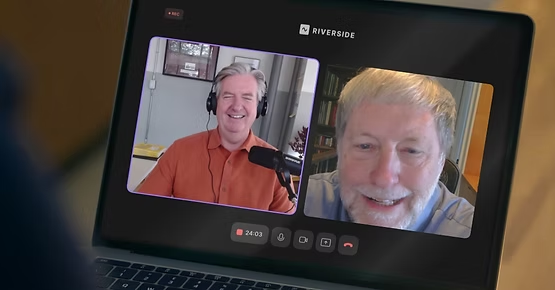
That was the topic of my recent conversation with the one-and-only Steve Strauss on The Unsure Entrepreneur Podcast.
I've been wanting to talk with Steve for years. He's one of America’s best-known small business voices. The bestselling author of The Small Business Bible and 17 other business books, Steve's spent more than 20 years as USA Today’s senior small business columnist, now writes for Inc. Magazine, and was named by SCORE Mentors as the country’s leading champion of small business.
He has spent decades studying entrepreneurs, writing about entrepreneurs, advising entrepreneurs, and being one himself.
So when Steve says this is a good time to start a business in America, it's worth hearing him out.
Golden Age of entrepreneurship
“This really is, I think, the golden age of entrepreneurship,” he told me. “Entrepreneurs are celebrated. If you look at who gets the juice in our culture, who gets the media, who gets the attention, it’s the entrepreneurs.”
That does not mean starting a business is easy.
It means the conditions are better than many people realize.
The U.S. currently has about 36 million small businesses. They represent 99% of all American businesses and employ about 62 million people. And there's more people starting up — the U.S. Census Bureau reports that new business applications for July 2026 increased 8.1% compared to June 2026.
These are not all large firms with offices, staff, and investors. Many are one or two-person companies. They are the local shop, the consultant, the online seller, the tradesperson, the home-based service provider, and the owner who knows every customer by name.
Steve’s appreciation for small business began when he was a child in Southern California. His father owned a carpet business and gave him a definition he never forgot.
“I asked him, like, ‘Oh, Dad, what do I say you do?’ And this is like 1972 maybe 1970, you know, and he goes, ‘Well, Stevie, I’m an entrepreneur.’ People did not banter that word around back then. He said, ‘An entrepreneur is a person who takes a risk with money to make money.’ I’ve heard lots of definitions over the years, but maybe because that was my dear old Dad gave me that one. I like that one a lot.”
That definition has aged well.

Entrepreneurship still involves risk. But the risk today is different from the risk faced by earlier generations. You no longer need to rent a storefront, hire staff, buy equipment, and hope enough customers show up. You can start smaller. You can test an idea. You can launch from home. You can sell through platforms. You can use AI, websites, newsletters, podcasts, online ads, and payment tools that did not exist when many older business owners began.
You can also get help.
Steve pointed to SCORE, the Small Business Administration, mentors, podcasts, training programs, and websites as proof that new entrepreneurs do not have to figure everything out alone.
As I said to Steve during the episode, “There’s never been a better time to start a small business, because, like you said, 30, 40, 50 years ago, yeah, you needed a couple hundred grand and an office, and maybe a staff, and a factory, or whatever, but today I can open a Shopify store this afternoon if I wanted to.”
That is the real shift — the barrier to starting has dropped. But the need for common sense has not.
Talk to people who are already in business
Steve is not telling people to quit their jobs and leap. In fact, he says the opposite. If you have a job, keep it while you test your idea. Talk to people who already run the kind of business you want to start. Ask them how they make money, how they find customers, what goes wrong, what they would avoid, and what they would do sooner.
That advice is old-school in the best sense. Learn the trade before you hang the sign.
Steve shared another lesson from youth that shows why experience matters. His first job was in his father’s carpet warehouse. He drove a forklift with a long pole on the front, raised it too high, and put it through the wall into his father’s office.
“That was my last day working at the carpet store,” he laughs.
It is a funny story, but it also says something about business. You learn by being around it. You learn by making mistakes. You learn that every business has a back room, a set of problems, and a rhythm outsiders do not see.
That is why Steve urges people to get close to the business before they start one.
If you want to open a restaurant, work in one first. If you want to start a service company, talk to owners. If you want to sell online, prove someone will buy before you build too much around the idea.
Small business is positive
There is optimism in Steve’s message, but there is no hype.
He believes America needs more entrepreneurs because entrepreneurs build things.
“What I love about entrepreneurs, what I love about small business is it’s positive,” he said. “You are making, and it’s not so easy to build something. Creating a business, that takes work, that takes creativity, and vision, and persistence, and lots of positive things. And then, when you do it, you’re making money for yourself and for your family, and you’re adding to the tax base. Maybe you’re creating jobs and giving someone hope.”
That is the part we should talk about more.
Small business is not just an economic category. It is how people turn skill, ambition, frustration, and necessity into ownership. It is how a person who hates their job can build a service company. It is how a mid-career worker can become a consultant. It is how a teenager can build a jewelry business between classes. It is how someone with an idea can take one step before taking a bigger one.
Steve also makes clear that business ownership is not for everyone. Some people are better suited to employment. Some people do not want the uncertainty. Some people do not have the family support, market opportunity, or sales ability needed to make it work.
That honesty matters.
Learn, then decide
America does not need everyone to become an entrepreneur.
It needs more people to see entrepreneurship as a real option.
That is where the opportunity sits right now. The tools are better. The cost of entry is lower. There's billions of dollars in financing available. The support systems are stronger. The culture pays attention to founders in a way it did not when Steve’s father called himself an entrepreneur in the early 1970s.
If you feel the pull of entrepreneurship, this is the moment to learn more before you decide.
That may mean keeping your job while you test the idea. It may mean talking to three or four business owners who already do the thing you want to do. It may mean working in the industry first, so you can see the margins, the customers, the staffing problems, the sales process, and the daily pressure from the inside.
Steve’s advice is simple and worth taking seriously.
“You need to learn the business first before you go start a business,” he says.
Resources:
Check out Steve's website PlanetSmallBusiness.
See how Score Mentors can help your business succeed.
Watch our full interview on YouTube.


Comments